With trade season officially upon us, many fans are salivating at the prospect of a juicy blockbuster megadeal suddenly catapulting their team into contention. But not every Luka Doncic that falls out of the sky can lead a championship charge straight away. And most teams with title dreams are too over-leveraged to swing a deal for a superstar anyways.
Smart front offices know that sometimes with a tweak here and a tinker there, they can still conjure up a larger slice of Championship Equity pie. There’s no replacement for top-level talent, but if you already have your franchise cornerstones in place, then upgrading on the margins can move the needle more than the reputation of the incoming player may suggest.
Let’s take a look at some specific role-player archetypes commonly found on contenders, and who around the association may be available at the deadline to fill those specific holes.
Note: All stats as of games played through January 11.
Kris Dunn
Archetype: The Defense and Dimes Glue Guy
Recent analog: 2022 Celtics trade for Derrick White, make the Finals
This is probably my favorite archetype, although one that we perhaps don’t have an officially recognized name for (shoutout to the Thinking Basketball crew for coining the “Defense and Dimes” moniker). It’s typically a guy who entered the league as a point guard, but didn’t have the requisite ball skills to drive offense at the highest level. Thus, they slid into more of an off-ball role, where their point guard pedigree made them excellent connective tissue playmakers and gave them a chance to develop a decent outside shot. But their true calling card is their intense, versatile, ball-hawking, game-wrecking defense.
You’d be hard pressed not to find a guy who fits this mold on any recent title team. From White to Alex Caruso to Jrue Holiday, Bruce Brown, and Gary Payton II, these players have become a staple on championship rosters.
Dunn could be next if he lands in the right situation. After being drafted fifth overall in 2016, Dunn nearly crashed out of the league as one of the bigger draft busts of the decade. But he reinvented himself as a gritty defense-and-dimes guy to get back in the league and into the starting lineup of a playoff team with the Clippers last season.
Dunn is a hellhound defensively, able to stonewall opposing ball-handlers at the point of attack and pressure the full length of the court. Even though he stands just 6-foot-3, Dunn is capable of guarding well up in size, often drawing the assignment of big wings like Cade Cunningham, whom he held scoreless for the first half of LA’s recent win over the East-leading Pistons.
In addition to his on-ball guarding prowess, Dunn is an excellent team defender as well, understanding where and when to help, switch, and rotate.
Clip: Dunn navigates a screen to cut off Cade and erase the dunk.
On the other side of the court, defenses have long given Dunn the Tony Allen treatment, completely ignoring him away from the action to load up on his star teammates. In the past, Dunn has been unwilling and unable to make defenses pay from the perimeter, but that’s starting to shift. After getting up just 3.6 threes per 100 possessions over his first eight seasons, Dunn is launching 5.9 per 100 in two years with the Clippers. Defenses haven’t started paying attention yet, as this season 97 of his 115 attempts have been wide open. However, Dunn is canning a healthy 40.2 percent of those. That’s major progress.
Dunn is also savvy enough to know how to maximize the space he’s given off the ball, flashing to the soft underbelly of a defense to serve as a pressure-release valve before ripping it open with pinpoint passes to open shooters.
Clip: Dunn flashes to the nail, then hits the shooter.
Clip: Another pressure-release find.There’s a role for Dunn on any contender. And with a minuscule salary in the $5 million range, pretty much any team that wants him will be able to make the cap math work.
Keon Ellis
Archetype: The 3-and-D Wing
Recent analog: 2024 Mavericks trade for PJ Washington, make the Finals
What’s the golden rule for any front office with a brain? Call the Kings first.
Sacramento’s smoking carcass has some valuable meat on its bones, and no morsel is juicier than Ellis - the classic 3-and-D wing all good teams lust after. This car crash of a Kings season has taken its toll on Ellis. His minutes have been yanked around like a toddler holding a balloon. Here were his minutes totals for each game played in December: 20, 9, 15, 31, 0 (DNP-CD), 32, 10, 9, 4, 32, 22, 19. I don’t think he has any notion of what his role will be on a game to game basis, and his overall output has suffered as a result.
Ellis is shooting a mediocre 36 percent from distance this season, but has demonstrably proven to be an upper echelon shooter over the course of his brief career. Over his first three seasons combined, Ellis nailed nearly 43 percent of his treys on roughly league average volume. I’m willing to bet on that track record. Even this year, he’s still connecting in 41.1 percent of his wide open attempts. On a real team, I believe his shooting will shine.
What hasn’t suffered (thankfully) is his voracious appetite for defending his tail off. Listed at 6-4, 175 lbs, Ellis is slight of build for your archetypical 3-and-D profile. But he makes up for it in effort and focus, ranking in the 99th percentile of shots contested per 100 possessions.
Clip: Ellis blows up a closeout and erases the corner three.
That toughness and tenacity enables him to guard up in the positional spectrum. Jerami Grant thinks he has a mismatch he can exploit down on the block. Ellis proves him wrong.
Clip: Ellis holds up on the block.
It’s rare to see Luka Doncic get a three-point attempt blocked, no less by someone he’s got four inches on.
Clip: Ellis blocks Doncic’s three.
Ellis’ nose for the ball is evident no matter where he’s positioned on the court. His defensive playmaking dashboard on Databallr is off the charts. His steal rate is in the 96th percentile. Block rate in the 94th. Deflections in the 95th. Forced turnovers per 100 possessions relative to league average? That’s in the 98th percentile. So is his overall Stop percentage (defined as steals, offensive fouls drawn and blocks recovered by the defense per 100 possessions).
Clip: Another defensive playmaking sequence.
A defensive dynamo who can bury open threes is a coveted asset across the league. With an expiring contract that amounts to little more than a rounding error ($2.3 million), teams should be falling over themselves to acquire Ellis down the stretch.
Collin Sexton
Archetype: The Microwave Scorer
Recent analog: 2018 Cavaliers trade for Jordan Clarkson, make the Finals
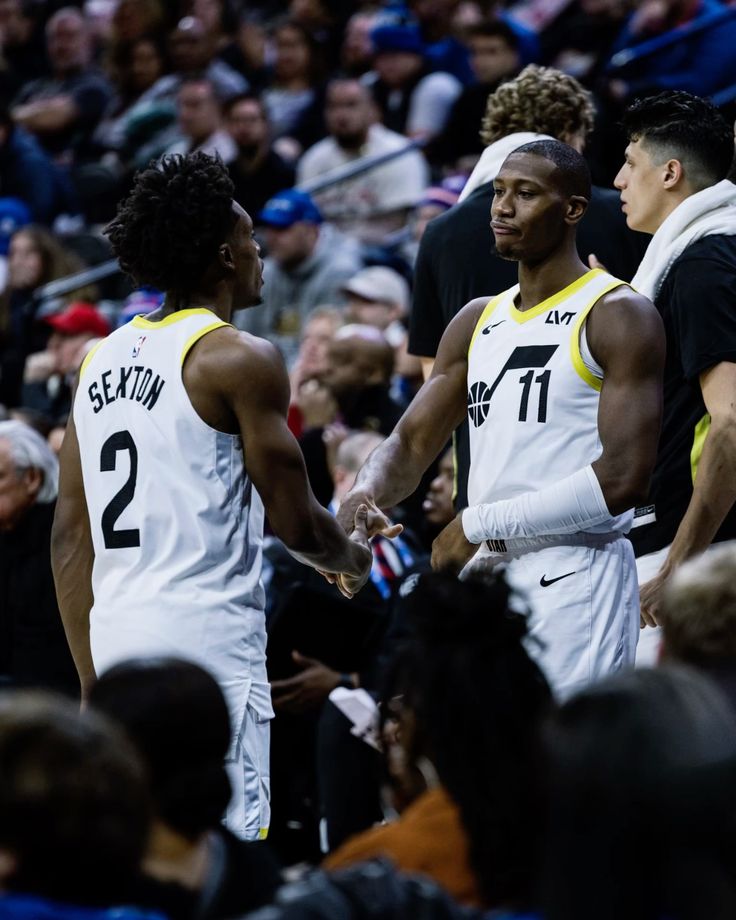
Once a founding member of the promising Sexland backcourt in Cleveland, Sexton has been wasting away for years on tanking cellar dwellers, first in Utah and now in Charlotte. The man can still generate offense, though. Since departing Cleveland, Sexton has averaged about 24 points and six assists per 36 minutes. He’s blended that volume with sparkling efficiency too, shooting 49 percent from the field, 40 percent from three, and 85 percent from the line, good for a True Shooting percentage north of 60 over that span.
Sexton has developed into a legitimate three-level scorer. He’s an elite finisher for his size, converting 70 percent of his attempts at the cup this season (better than Stephen Curry, Donovan Mitchell, or Tyrese Maxey), with a fearless ability to play through contact.
Clip: Sexton finishes through contact.
He’s also shown an increasing willingness to space the floor for others away from the primary action. Just 11 percent of his triple tries came from the corners over his first four campaigns. But over his last four, that figure has nearly doubled to 20 percent of his attempts from beyond the arc. And he’s laced them at a scintillating 45.5 percent clip.
Clip: Sexton buries a corner three.
If you look at his offensive dashboard over on Databallr, it’s chock-full of green flags. Sexton’s relative True Shooting on Creation playtypes is in the 69th percentile. On Spacing playtypes it’s in the 85th percentile. On Finishing it’s in the 92nd. His teammates’ effective field goal percentage off of his potential assists is in the 67th percentile. His rim assists per 100 possessions is in the 74th. Overall, his 3-year offensive RAPM is in the 92nd percentile. Folks, this is a pulsating offensive weapon just waiting to be detonated in the postseason.
The former No. 8 overall pick just turned 27 years old, so he’s smack dab in the middle of his prime, and as an unrestricted free agent this summer, Sexton will want to prove his value to the league by contributing to wins for a contender.
Robert Williams III
Archetype: The Defensive Anchor
Recent analog: 2024 Mavericks trade for Daniel Gafford, make the Finals
If you forgot that Williams was on the Blazers roster I wouldn’t blame you. It seems like forever ago now, but less than one full presidential term has passed since Williams anchored Boston’s top-ranked defense all the way to the NBA Finals. His exploits earned him All-Defensive 2nd Team honors, as well as a place in the DPOY discussion (he finished 7th in the voting).
After suiting up for the Celtics 61 times that year, Williams played a forgettable 61 games over the next three seasons combined, and is now languishing on a Portland team that has selected centers in the first round of back-to-back drafts, including with the No. 2 overall pick in 2024.
While he’s not producing eye-catching numbers, his lone start of the season saw him compile 14 rebounds and five rejections. But the most important stat with Williams is the games played column. He’s at 27 and counting so far, easily on pace to hit his highest total since 2022.
Still just 28 years old, Williams hasn’t lost the ability to protect the paint at an elite level. According to NBA.com player tracking, only six players league-wide have accounted for a larger differential in field goal percentage on shots defended inside of six feet.
Clip: Williams swallows the paint.
And although he’s best deployed as a drop coverage rim deterrent, when healthy he’s not an easy target on the perimeter either.
Clip: Williams survives on the perimeter.
On offense, Williams is a vertical spacer and lob threat. His 76.4 percent two-point conversion rate would lead the league if he had enough volume to qualify. And he’s always been a nifty passer for a traditional rim-roller type. Not many bigs have the gumption to eschew a simple dribble handoff action to fire a one-handed laser crosscourt into the shooting pocket.
Clip: Williams fires the crosscourt laser.
As an impending free agent that has no future with his current franchise, Williams is a prime candidate to hit the trade market, and any team needing to plug a leak in the middle should put in a call to Portland.
Comments